Wednesday, December 25, 2019

Our Blog has Moved!


We finally launched our new website - TheLongShotFarm.com - and our blog,  "The Chronicles of the Long Shot Farm",  moved to the new site. 

All the old posts are still a available, and you can still follow our adventures as we grow grapes and make wine, celebrate holidays, craft and cook, as well as the odd DYI projects.


Check it out (and feel free to subscribe if you are interested):

  https://thelongshotfarm.com/blog/

Saturday, April 6, 2019

Why We Use Cork in Our Winery

Cork is a sustainably harvested product that is natural, renewable and recyclable.  Cork forests support high levels of biodiversity and prevent desertification in the Mediterranean region , where most of these forests are found. Additionally, cork oak trees store carbon in order to regenerate their bark.  According to WWF, a harvested cork oak tree absorbs up to five times more carbon than one that is not, and cork forests absorb millions of tons of CO2 each year.  With a global decline in the natural cork use for wine, cork trees are being lost and countries are experiencing desertification, which also threatens the habitats of some critically endangered species, like the Iberian Lynx in Portugal.

Let's start with a brief summary of the types of wine bottle closures:

Natural Corks
Natural cork has several advantages, it is a natural product, it is porous and traditionalists will say that cork creates the perfect oxygen/wine ratio for cellar aging. The oxygen transfer rate of natural cork is approximately 0.0179 mg/L or between 3.00 and 6.83 micrograms of O2/day. Cork is also recyclable and cork forests contribute to biodiversity and prevent desertification of the Mediterranean region. A high quality cork offers long term aging potential, though with very high end wines it is recommended to re-cork after 25 years, as the cork will start to fail at that time.

But there are some major disadvantages, including problems with leakage as well as sources of off-odors. Leakages can be caused by structural imperfections of the cork itself, of it could be caused by wrongly aligning the cork and bottle during the corking process. Rapid temperature changes may also cause leakage. Another serious problem with cork is the possibility of off odors, including TCA (Trichloroanisole), as well as microbial growth from a variety of sources.

Concerns about structural imperfections of corks as well as cork taints have been the major reason for the development of alternative closures.

Synthetic Corks
Synthetic corks are inexpensive, they are consistent and they will never have the taint issues of real cork. They can also be used without the need for new bottling equipment. However, plastic allows the diffusion of oxygen at varying levels, ranging from 0.0052 cc/day to 0.0076 cc/day, while other evaluations of synthetic cork show diffusion from 5.7 to 13.99 micrograms of O2/day. Oxidation of wines under a synthetic cork can be observed as early as in a year, though ongoing research is addressing this issue. Plastics are not generally a renewable resource.

Screw Caps
Metal screwcaps are a major alternative to cork when it comes to closures. The metal cap itself is not the actual closure; rather the bottle is sealed with a plastic foam pad that is either lined with saran and a tin layer, or saranex only. A main advantage of these closures is that they are very consistent; they are great at retaining SO2 and they minimize oxidation. They are pilfer proof, and eliminate the need for a cork screw. There is no risk of TCA and the bottles do not need to lie on their sides.

There is some research suggesting that screw caps may lead to reduction in wine (the opposite of oxidation.) And there is still disagreement as to the aging potential of wine closed with a screw cap. Another disadvantage is the cost of investing in a capping machine, which starts around $8000. The various types of screw caps in the market are not standardized so a capping machine is specific to one type of screw cap only.

"Engineered" or "Technical" Corks
A technical or engineered cork is basically made of shredded natural cork that is then “glued” back together and molded into the traditional cork shape. This type of cork provides all the advantages of natural cork, but eliminates the problems of cork taint (from musty smells to TCA) and inconsistencies with oxygen permeation caused by technical imperfections. Different grades of cork are used in this process, which - just as with the natural cork - influences the number of years that the cork is guaranteed for. This typically ranges from 2, 3, 5 and 10 years.

Regarding overall market perceptions, cork closures are still the preferred method of closures in the US for all wines, but even in countries where alternative closures are well accepted, many wineries opt to use traditional cork closures.

When deciding about the best wine closure, the overall environmental impact should not be underestimated! Cork is a sustainably harvested product. It is produced primarily by the Cork Oak (Quercus suber), but the tree does not get cut down in order to harvest the cork. The cork oak is the only tree, where all the bark can be stripped without harming the trunk. Harvesting cork starts when a tree is around 30 years old, and is repeated every 10 years or so - for about 200 years per tree.

We know that by using natural cork, we are helping save cork trees in Portugal, across Europe, and in the Mediterranean region!

Here are some links where you can learn more about how corks are sustainably harvested and the importance of cork trees:

Cork Forest Conservation Alliance

"Save a Tree, Use Real Cork" The New York Times, 2013

Cork Quality Council

Sunday, March 24, 2019

First Weekend Open 3/23


beautiful out but it is windy.  The deck is ready, the tasting room is buzzing with anticipation and cars are in the parking lot at 4:51.  The Winery is finally opening to the public.

Friday evening started out beautiful but the weather became so cold and windy that is was impossible to enjoy a drink on the deck.  However, many guests enjoyed a brief peak at the view.  As a result everyone was inside.  There were not enough chairs so Tina brought her own dining room chairs over from the house.  People lined the hallways, the bar, and just stood around holding drinks and balancing their flights.Speaking of flights…they weren’t something that we were originally going to pursue.  But by 6 o’clock someone had asked about them, and by 7 we were out of dishes.  Saturday morning a quick run to the restaurant store secured more flight boards and glasses. We are selling flights for $10 now and it’s a great way to taste 4 of our wines.

Samantha and Rachel manned the bar, while Tina and Jeff answered questions
Lars was running around carrying cases of wine, restocking behind the bar and running the dishwasher
No one was really sure what to expect.  Will people just stop in, buy something and leave? Will people want samples? Should we do free samples?  Will people hang out? Will anyone even come? But by Sunday the Weyants were relieved to learn that all of their hard work over the past decade had culminated in a successful opening weekend.

Monday, March 18, 2019

Winery Sign


The Winery has a sign! It was designed by Samantha and cut out of steel by Agar Welding Service and Steel Supply with a plasma cutter.  Jeff, Zach, and Lars sunk 4×4’s into the ground, attached the metal sign and added a board below with our opening hours. The bottom portion of the sign was printed by Vispronet.  Come check it out!

Saturday, January 19, 2019

Finishing the Bar Top

We had purchased a large, live edge, unfinished slab of wood to use for the bar top.  After rough sanding it with a belt sander, we finished it by hand-sanding, using finer and finer sandpaper between applying coats of high gloss polyurethane.  We started off with 80 grit sandpaper and at the end we were using 800 grit sandpaper!  It took about 30 coats of polyurethane and sanding (we lost track of the exact number) over a period of two months.  But it was so worth it:


Saturday, October 27, 2018

Labeling Wine Bottles

Every new wine label needs to be approved by the federal  Alcohol and Tobacco Trade and Tax Bureau, TTB for short. (Wine labeling rules are found in Title 27 of the Code of  Federal Regulations) After the approval, they can be printed and applied.  We use a manual labeler, which we really like:


Sunday, October 14, 2018

Sign Installed

Sammy designed the sign for the winery which was produced by a local welding shop, Agar Welding.  We installed it this weekend:


Saturday, September 15, 2018

Concord Harvest

We are in the middle of harvesting our Concord grapes - and ever so thankful for the large walk-in cooler that allows us to store the grapes before crushing them.


Saturday, June 30, 2018

HVAC and Dishwasher

We are happy to report that the future tasting room now boasts a heating and cooling system, which we promptly turned to cooling.  It is amazingly quiet and works great.


The other major addition this week was a commercial dishwasher!


Sunday, June 24, 2018

Deck Railing Finished

We chose wire, rather than wood, for the deck railing to offer a better view of the vineyard.  Installation was finished today and it looks amazing.


Saturday, June 23, 2018

Deck Railing and Ramp


Progress continues this week, as the handicap ramp is taking shape. The decking boards, posts and railings were installed on the ramp, which will end with a cemented landing.    The deck also has a railing as of this week, and a door from the future tasting room to the deck was added.     
  

Saturday, June 2, 2018

Dark Chocolate Bundt Cake with Ganache Icing

This cake is one of our favorite chocolate cakes.  It contains sour cream, which typically results in a
moist cake that keeps well.  The dark chocolate ganache is a decadent icing, which further helps to keep the cake moist.  I usually store the cake under a glass cover.

Ingredients for the Cake:

1 cup butter
1/3 cup cocoa powder (I use Hershey's dark chocolate)
3/4 teaspoon salt
1 cup water
2 cups all purpose flour (I use King Arthur)
1 and 3/4 cups sugar
1.5 teaspoons baking soda
2 eggs
1/2 cup sour cream
1 teaspoon vanilla extract

Directions for the Cake:

1. Pre-heat oven to 350 F and thoroughly butter and flour a Bundt cake pan
2. Combine butter, cocoa, salt and water in a small pot, and heat on medium, stirring frequently until butter is melted (don't overheat). Set aside to cool a bit
3. Sift the flour, baking soda and sugar into a large mixing bowl (I use a KitchenAid with whisk for this cake)
4. Add about half of the melted butter mixture to the flour mix and start whisking until combined, then slowly add the remaining butter mixture
5. Add the eggs, one at a time
6. Add the sour cream and vanilla
7. Whisk until the batter is smooth (may need to scrape the bottom of the bowl with a spatula to make sure it is all blended together)
8. Pour batter into prepared cake pan and bake in center of oven for about 40 - 45 minutes, until toothpick inserted comes out clean. (my oven takes 44 minutes) Try not to over-bake it.
9. Place pan on cooling rack, and let cool down - about 15 minutes or so, before inverting onto cake plate.  Let cake cool some more.

Ganache Icing

Ingredients:
  • 1 cup chocolate morsels  
  • scant 1/2 cup heavy whipping cream

Combine 1 cup chocolate morsels (I use Hershey's dark morsel, can also break up high quality chocolate into small pieces) and scant 1/2 cup heavy whipping cream in a double boiler.  Heat on medium, stirring constantly.  Watch carefully, stir until all the chocolate is melted and the mixture gets shiny - pull of heat immediately (chocolate will temper quickly) and stir.  (if it seems too runny, add a few more morsels and stir them in)  While still very warm, spread ganache on the cake.

Saturday, May 26, 2018

Wine Label Design Finishing Touches

Samantha has been working hard on finalizing our wine labels.  The general design and layout had been done for a while, but we had to get the labels sized correctly to fit our various bottle shapes, and we had to meet the specs of the printer.  The draft labels have been printed on two different types of paper so that we could see how well each holds up.  We actually made the bottles wet and put them in the refrigerator, and submersed them in ice water buckets to test the paper.  Now that we have all this done, we are submitting each label for approval to the TTB.

We also selected different color schemes for the various wines, and tried to match those colors to the available bottle caps.


Here is an examples of our draft wine label:


Monday, May 7, 2018

Tasting Room Nearly Finished

Just realized that we had not posted any pictures of the nearly finished tasting room - so here we go:


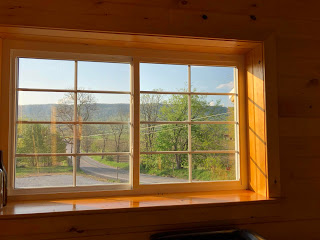
View from tasting room window

Sunday, April 29, 2018

Mulching the Vineyard

The weather finally got warmer and dried out the ground enough to use the mulch spreader in the vineyard.  Its the finishing touch after the first round of pruning: